
Corn prices near record high, but what about food costs?
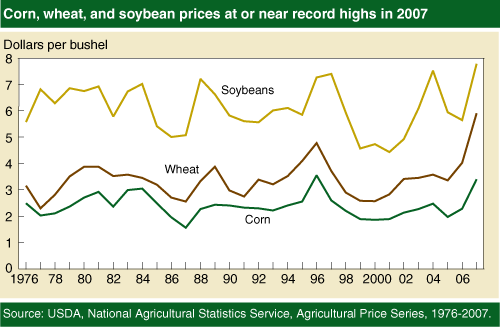
Record U.S. trade driven by economic growth in developing countries and favorable exchange rates, combined with tight global grain supplies, resulted in record or near-record prices for corn, soybeans, and other food and feed grains in 2007. For corn, these factors, along with increased demand for ethanol, helped push prices from under $2 per bushel in 2005 to $3.40 per bushel in 2007. By the end of the 2006/07 crop year, over 2 billion bushels of corn (19 percent of the harvested crop) were used to produce ethanol, a 30-percent increase from the previous year. Higher corn prices motivated farmers to increase corn acreage at the expense of other crops, such as soybeans and cotton, raising their prices as well.
What effect do these higher commodity costs have on retail food prices? In general, retail food prices are much less volatile than farm-level prices and tend to rise by a fraction of the change in farm prices. The magnitude of response depends on both the retailing costs beyond the raw food ingredients and the nature of competition in retail food markets. Ethanol’s impact on retail food prices depends on how long the increased demand for corn drives up farm corn prices and the extent to which higher corn prices are passed through to retail. ERS research has traced the effect of higher corn prices on U.S. retail food prices by analyzing data on price trends and price response of corn-dependent foods to cost changes.
Retail Competition Moderates Food Price Inflation
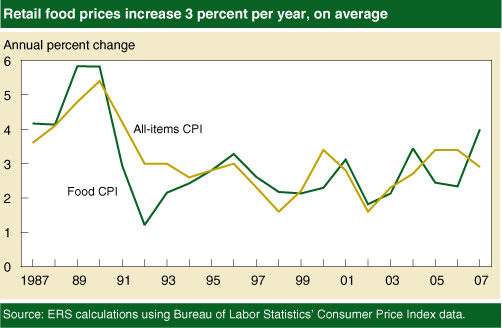
Retail food prices adjust as the cost of inputs into retail food production change and the competitive environment in a given market evolves. Strong competition among three to five retail store chains in most U.S. markets has had a moderating effect on food price inflation. Overall, retail food prices have been relatively stable over the past 20 years, with prices increasing an average of 3.0 percent per year from 1987 through 2007, just below the overall rate of inflation. The main exception occurred when sharply higher farm prices increased retail prices 5.8 percent in 1989 and 1990. Since then, food price inflation has averaged just 2.5 percent per year.
Retail prices are a function of both consumer demand and the interaction between food manufacturers, distributors, and retailers, with each group having some pricing power in the supply chain. Ultimately, though, the retailer has a more complicated pricing decision since it is selling a wider variety of products to a more diverse consumer clientele than most manufacturers or distributors. The challenge for the food retailer is to determine how best to distribute the costs of providing both food and services to consumers across a wide range of products. This pricing challenge removes some of the direct connection between the costs of a given product and the retail price charged.
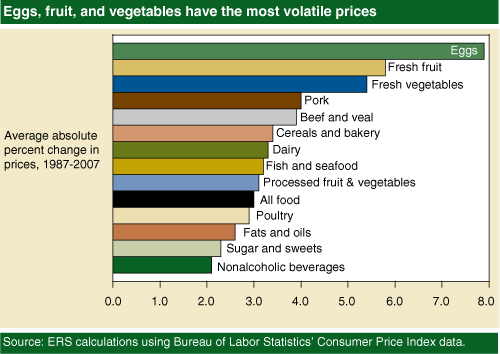
When there are cost shocks in the food production system due to changes in the commodity or farm product market, most retailers respond by passing on a fraction of their higher costs to consumers. Among factors affecting this pass-through rate is the level of processing and value-added services that take place between the farmgate and the grocery store aisle. Products that require more processing and packaging are usually less directly linked to changes in farm prices, while the price of less processed foods more closely follows the changes in farm prices. For example, changes in farm prices for eggs, fresh fruit, and fresh vegetables show up in more volatile retail prices for these less processed foods. The price volatility of pork and beef is also above the average for all foods. The other food categories average between 2.3 and 3.4 percent in price change per year.
Higher Farm Corn Prices, Slightly Higher Food Prices
Field corn is the predominant corn type grown in the U.S., and it is primarily used for animal feed. Currently, less than 10 percent of the U.S. field corn crop is used for direct domestic human consumption in corn-based foods such as corn meal, corn starch, and corn flakes, while the remainder is used for animal feed, exports, ethanol production, seed, and industrial uses. Sweet corn, both white and yellow, is usually consumed as immature whole-kernel corn by humans and also as an ingredient in other corn-based foods, but makes up only about 1 percent of total U.S. corn production.
Since U.S. ethanol production uses field corn, the most direct impact of increased ethanol production should be on field corn prices and on the price of food products based on field corn. However, even for those products heavily based on field corn, the effect of rising corn prices is dampened by other market factors. For example, an 18-ounce box of corn flakes contains about 12.9 ounces of milled field corn. When field corn is priced at $2.28 per bushel (the 20-year average), the actual value of corn represented in the box of corn flakes is about 3.3 cents (1 bushel = 56 pounds). (The remainder is packaging, processing, advertising, transportation, and other costs.) At $3.40 per bushel, the average price in 2007, the value is about 4.9 cents. The 49-percent increase in corn prices would be expected to raise the price of a box of corn flakes by about 1.6 cents, or 0.5 percent, assuming no other cost increases.
In 1985, Coca-Cola shifted from sugar to corn syrup in most of its U.S.-produced soda, and many other beverage makers followed suit. Currently, about 4.1 percent of U.S.-produced corn is made into high-fructose corn syrup. A 2-liter bottle of soda contains about 15 ounces of corn in the form of high-fructose corn syrup. At $3.40 per bushel, the actual value of corn represented is 5.7 cents, compared with 3.8 cents when corn is priced at $2.28 per bushel. Assuming no other cost increases, the higher corn price in 2007 would be expected to raise soda prices by 1.9 cents per 2-liter bottle, or 1 percent. These are notable changes in terms of price measurement and inflation, but relatively minor changes in the average household food budget.
Impacts Extend to Meats Through Higher Feed Costs
Given that livestock feed rations traditionally contain a large amount of corn, a bigger impact would be expected in meat and poultry prices due to higher feed costs than in other food products. Currently, about 55 percent of corn produced in the U.S. is used as animal feed for livestock and poultry. However, estimating the actual corn used as feed to produce retail meat is a complicated calculation. Livestock producers have many options when deciding how much corn to include in a feed ration. For example, at one extreme, grass-fed cattle consume no corn, while other cattle may have a diet consisting primarily of corn. For hog and poultry producers, ration variations may be less extreme, but can still vary quite a bit. To estimate the impact of higher corn prices on retail meat prices, it is necessary to make a series of assumptions about feeding practices and grain conversion rates from animal to final retail meat products. To avoid downplaying potential impacts, this analysis uses upper-bound conversion estimates of 7 pounds of corn to produce 1 pound of beef, 6.5 pounds of corn to produce 1 pound of pork, and 2.6 pounds of corn to produce 1 pound of chicken.
Using these ratios and data from the Bureau of Labor Statistics, a simple pass-through model provides estimates of the expected increase in meat prices given the higher corn prices. The logic of this model is illustrated by an example using chicken prices. Over the past 20 years, the average price of a bushel of corn in the U.S. has been $2.28, implying that a pound of chicken at the retail level uses 8 cents worth of corn, or about 4 percent of the $2.05 average retail price for chicken breasts. Using the average price of corn for 2007 ($3.40 per bushel) and assuming producers do not change their animal-feeding practices, retail chicken prices would rise 5.2 cents, or 2.5 percent. Using the same corn data, retail beef prices would go up 14 cents per pound, or 8.7 percent, while pork prices would rise 13 cents per pound, or 4.1 percent.
These estimates for meat, poultry, and corn-related foods, however, assume that the magnitude of the corn price change does not affect the rate at which cost increases are passed through to retail prices. It could be the case that corn price fluctuations have little impact on retail food prices until corn prices rise high enough for a long enough time to elicit a large price adjustment by food producers and notably higher retail food prices.
On the other hand, these estimates may be overstating the effect of corn price increases on retail food prices since they do not account for potential substitution by producers from more expensive to less costly inputs. Such substitution would dampen the effect of higher corn prices on retail meat prices. Even assuming the upper-bound effects outlined above, the impact of rising corn commodity prices on overall food prices is limited. Given that less than a third of retail food contains corn as a major ingredient, these rising prices for corn-related products would raise overall U.S. retail food prices less than 1 percentage point per year above the normal rate of inflation.
While higher commodity costs may have a relatively modest impact on U.S. retail food prices, there may be a greater effect on retail food prices in low-income developing countries. As a relatively low-priced food, grains have historically accounted for a larger share of the diet in less developed countries. Even with incomes rising, consumers in such countries consume a less processed diet than is typical in the U.S. and other industrialized countries, so food prices are more closely tied to swings in both domestic and global commodity prices.
Markets Adjust and Prices Stabilize
Continuing elevated prices for corn will depend on the extent to which corn remains the most efficient feedstock for ethanol production and ethanol remains a viable source of alternative energy. Both of these conditions may change over time as other crops and biomass are used to produce ethanol and other alternative energy sources develop.
Even if these conditions do not change in the near term, market adjustments may dampen longrun impacts. In 1996, when field corn prices reached an all-time high of $3.55 per bushel due to drought-related tighter supplies in the U.S. and strong demand for corn from China and other parts of Asia, the effect on food prices was short lived. At that time, retail prices rose for some foods, including pork and poultry, but these effects did not extend beyond the middle of 1997. For the most part, food markets adjusted to the higher corn prices and corn producers increased supply, bringing down price.
Food producers, manufacturers, and retailers may also adjust to the changing market conditions by adopting more efficient production methods and improved technologies to counter higher costs. For example, soft drink manufacturers may consider substituting sugar for corn syrup as a sweetener if corn prices remain high, while livestock and poultry producers may develop alternative feed rations that minimize corn needed for animal feed. Adjustments by producers, manufacturers, and retailers, along with continued strong retail competition, imply that U.S. retail food prices will remain relatively stable.
by Ephraim Leibtag - USDA
This article hasn't been commented yet.

Write a comment
* = required field